
Building Resilience: How to Let Your Child Fail Safely
Resilience is built through “Productive Failure”—allowing children to experience small, manageable setbacks without immediate adult intervention. To foster resilience, parents should adopt the role of a “Consultant” rather than a “Fixer,” focusing on the process of problem-solving rather than the final result. By validating the frustration of failure while encouraging “Pivot Thinking,” children develop the Growth Mindset necessary to navigate the complexities of adult life. This also strengthens emotional intelligence in kids.
The “Fixer” Trap
In the corporate world, “Zero Downtime” is the goal. We build redundancies to ensure nothing ever fails. But in parenting, if you build a life with “Zero Failure” for your child, you are actually creating a Systemic Vulnerability. It can also limit autonomy in child development because children depend on adults for every solution.
If we always swoop in to bring the forgotten tiffin to school, or “fix” a broken toy before they cry, we are denying them the chance to build Internal Troubleshooting skills. Resilience isn’t something you are born with; it’s a “muscle” that only grows when it meets resistance. To raise a child who is “More,” we have to be brave enough to let them fail safely.
1. The Concept of “Productive Struggle.”
In UX design, we look for “friction” that stops a user. In parenting, we need to distinguish between “Destructive Friction” (which crushes a child) and “Productive Struggle“ (which teaches them).
This type of challenge encourages learning through experience and stronger emotional development in children.
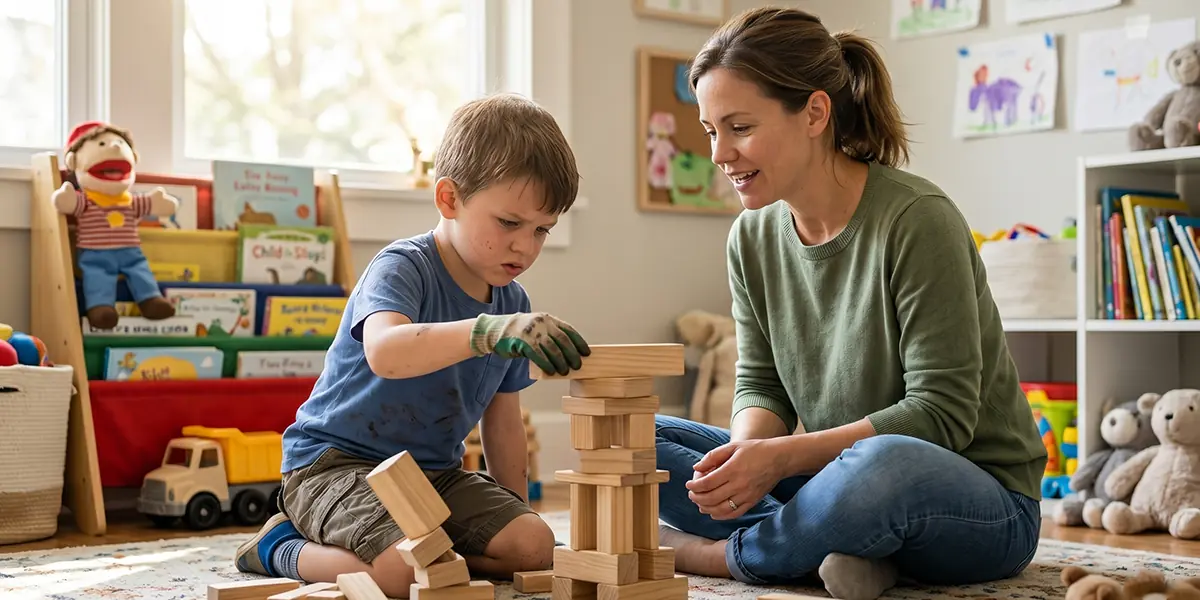
- The Scenario: Your child is struggling to build a block tower that keeps falling.
- The Fixer Move: You build it for them so they stop crying. (Result: They learn they need you to succeed).
- The Resilience Move: You sit nearby and say, “That’s frustrating when it falls. I wonder if the base needs to be wider?” (Result: They learn strategy).
2. Reframing Failure as “Beta Testing.”
We need to change the vocabulary of failure in our homes. Instead of failure being an “End State,” we should treat it like a Beta Test.
- Did the science project fall apart? That’s just a bug in the first version.
- Did they lose the race? We just found a gap in the training data. When failure is treated as Data Input rather than a Character Flaw, children become more willing to take risks. This is the foundation of the “Growth Mindset.” It improves emotional intelligence in kids.
3. Creating a “Safe Sandbox” for Failure
To let a child fail “safely,” you must define the boundaries of the sandbox.
- Physical Safety: Obviously, we don’t let them “fail” at crossing a busy street.
- Emotional Safety: They must know that your love is a Constant. If they fail at a task, your “Rating” of them as a person doesn’t drop.
- Financial/Social Safety: Let them spend their pocket money on a “bad” toy. The 500-rupee lesson at age 7 is much cheaper than the 5-lakh lesson at age 27. This practical lesson is valuable learning through experience.
4. The “Post-Mortem”: Teaching the Pivot

In a professional agency setting, when a campaign fails, we don’t just mourn; we conduct a Post-Mortem. We analyze the data to see where the “leak” was. We should teach our children the same.
Once the initial tears have dried, guide them through a “Recovery Protocol”:
- Acknowledge the Emotion: “It’s okay to be frustrated. That was a big goal.” (Validation). This builds emotional intelligence in kids.
- The Technical Audit: “What part of the plan didn’t work? Was it the materials, the timing, or the strategy?
- The Pivot: “What is one thing we can change for ‘Version 2.0’?”
By doing this, you are shifting their brain from the Amygdala (emotional center) to the Prefrontal Cortex (logical center). You are teaching them that failure is a temporary state of data-gathering.
5. Modeling “Expert Failure”
The most powerful tool for building resilience is Mirroring. If your child sees you lose your temper when a digital project goes sideways, or a client rejects a proposal, they learn that failure is a threat.
- The “Oops” Share: Start sharing your small professional “fails” at the dinner table. “I made a mistake in a spreadsheet today, and I had to spend an hour fixing it. I felt annoyed, but then I learned a new shortcut!
- The Outcome: When they see an “Expert” (you) handle failure with grace and a solution-oriented mindset, they realize that they can, too. You are building their Antifragility and strengthening emotional development in children.
Conclusion: Raising the “Unshakeable” Child
Our job isn’t to prepare the path for the child; it’s to prepare the child for the path. When we step back and allow them to face small obstacles today, we are ensuring they don’t crumble under large ones tomorrow. This long-term approach supports autonomy in child development.
A resilient child doesn’t just “survive” the high-pressure environments of the future—like the intense [Competitive Exams in India] we discuss in Track B—they navigate them with their mental health and self-worth intact. Resilience is the ultimate “System Upgrade” for the modern world.