

Digital Consent: Teaching Kids to Own Their Image in a Social World
In today’s world of parenting in the digital age, families are constantly balancing connection with protection. As digital marketing strategists, we understand that data is permanent.
But as parents, we often overlook the most significant data set we manage: our children’s lives. In a world of “sharenting,” teaching our kids about digital consent isn’t just a nice-to-have—it’s a critical life skill for the 2020s.
1. The “Pause Before the Post” Rule
The best way to teach consent is to model it. Before you upload that cute “first day of summer” photo, ask your child (if they are age 3+): “I love this photo of you. Can I share it with our friends online, or should we keep it just for us?”
- The Strategy: By giving them “veto power,” you are teaching them that they own their physical and digital image. These small conversations also become practical kids online privacy tips that children remember as they grow older.
2. Understanding the “Digital Tattoo.”
Explain to older children that a post isn’t a “sketch”—it’s a “tattoo.”
- The Analogy: Use the term “permanent ink.” Once a photo is shared, we lose control over where it goes or who sees it.
- The Boundary: Establish “No-Fly Zones”—bathrooms, bedrooms, or moments of vulnerability (like tantrums or being upset) should never be shared.
Setting these kinds of social media boundaries helps children understand respect and long-term consequences online.
3. The Rights of the “Future Adult.”
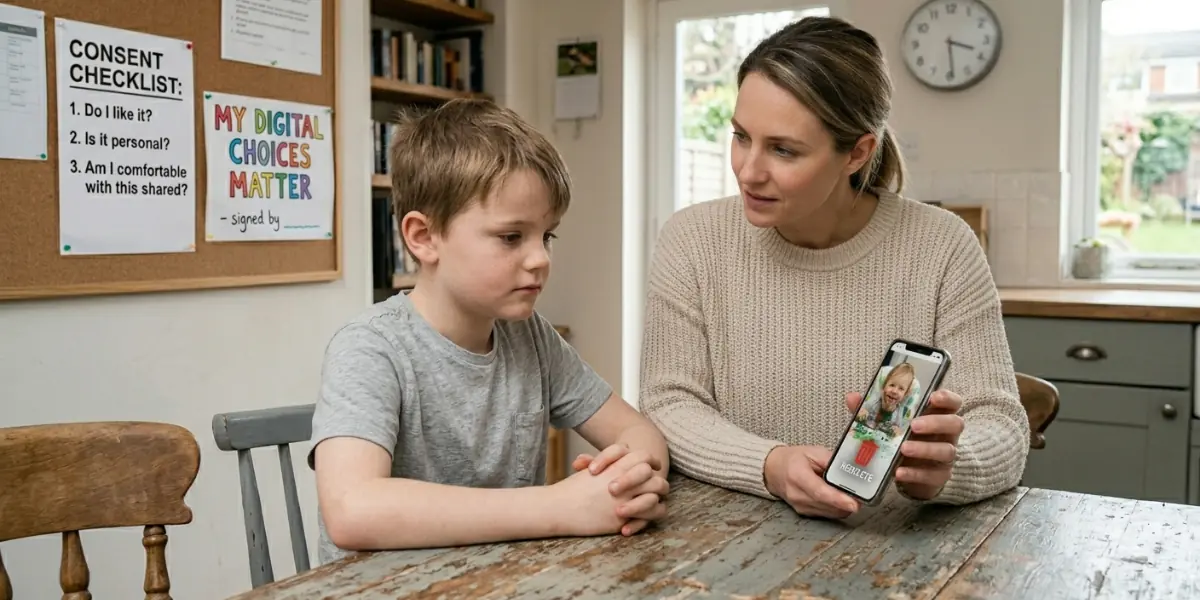
We often post for our current audience (family and friends), forgetting the future audience (the child’s future employers or peers).
- The Audit: Periodically go through your own social media and delete old photos that your child might find embarrassing as they grow. This shows them that privacy is a dynamic, ongoing choice.
These habits are central to Cyber safety for children because they teach kids that digital choices can follow them into adulthood.
Picture Suggestions:
- A close-up of a parent showing a photo on a phone to a child, with the child giving a “thumbs up” or “thumbs down.”
- A conceptual image of a “digital footprint”—a child’s footprint made of binary code (0s and 1s).
- A “Privacy Checklist” infographic for kids: Is it kind? Is it private? Do I have permission?
- A family “tech agreement” is signed and posted on a corkboard.
4. The “Digital Footprint” Audit: A Shared Family Activity
Teaching consent isn’t just about what we don’t post; it’s about managing what is already out there.
- The Activity: Sit with your child and search for your own name or theirs on Google.
- The Lesson: Explain that every photo is a piece of a puzzle that people use to understand who they are. Ask, “Does this photo show the version of you that you want the world to see?”
- The Action: If there’s a photo they no longer like, delete it together. This demonstrates that consent is dynamic—what was okay at age 4 might not be okay at age 7.
It also reinforces healthy digital parenting strategies that build trust between parents and children.
5. Peer-to-Peer Consent: Beyond the Family

As children move into summer playdates and [Tricity Summer Camps], they will be around other kids with phones.
- The Rule: Teach them the “Ask First” etiquette for their friends. “Before you take a selfie with your friend, ask them, ‘Is it okay if I take this? Is it okay if I show my mom?”
- The Goal: You are training them to respect the boundaries of others, which is the cornerstone of preventing cyberbullying and privacy leaks later in life.
Teaching peer consent also supports cyber safety for children by helping kids understand that privacy belongs to everyone, not just them.
The Professional Strategy: Why “Sharenting” is a Business Risk
As a strategist, you know that personal branding is an asset. By oversharing our children’s lives, we are essentially “pre-writing” their brand before they have a chance to.
- The Pivot: Move your content strategy toward “Face-less Sharenting.” Share the activities, the crafts, and the [Analogue Bag] ideas, but keep the child’s identifying features private. This allows you to build a high-traffic blog while protecting their future professional autonomy.
As families continue adapting to parenting in the digital age, the goal is not to remove technology completely—it is to create safer, smarter, and more respectful digital habits for everyone.
Additional Picture Suggestions:
- The Audit: A photo of a parent and child sitting side-by-side at a laptop, looking at the screen together with a sense of “teamwork.”
- The Handshake: A close-up of two children “high-fiving” or agreeing before taking a photo with a toy camera.
- The Privacy Graphic: An infographic titled “The 3-Step Consent Check” (1. Ask, 2. Listen, 3. Respect).