Traditional Indian Indoor Games: Why Pachisi & Chaupar are Making a 2026 Comeback
As the temperature in the Tricity hits that familiar 42°C mark, the “Outdoor vs. Indoor” debate in every Indian household is settled by the sun. Between 11 AM and 5 PM, our homes become sanctuaries. But for the modern parent, this sanctuary can quickly feel like a digital cage.
In this season, traditional Indian indoor games are becoming a natural solution for families seeking meaningful engagement.
In our quest to find the “next best thing” to keep our children engaged, we often look toward expensive STEM kits or international toy brands. However, in 2026, a beautiful trend is emerging in living rooms from Chandigarh to Bangalore: The Great Indian Games Revival.
Pachisi, Chaupar, and Goti are no longer just stories our grandparents tell; they are the ultimate tools for summer survival. Here is why these ancient games are the perfect “Track B” accompaniment to your [Analogue Reset].
1. The Geometry of Pachisi: More Than Just a “Cross and Circle”
Often called the “National Game of India,” Pachisi is the ancestor of Ludo, but with a strategic depth that Ludo lacks. The debate of Pachisi vs Ludo often highlights how traditional gameplay demands more thinking and planning than modern simplified versions.
The benefits of ancient Indian games are clear here, as Pachisi trains young minds in probability and decision-making.
While Ludo relies heavily on the luck of the dice, Pachisi—traditionally played with cowrie shells (kaudi)—requires a level of mathematical probability and risk assessment that rivals modern board games.
- The Developmental Edge: For a 5 or 6-year-old, counting the cowries and calculating the “safe squares” is a lesson in mental math disguised as play.
- The Sensory Connection: The sound of cowrie shells hitting a wooden floor or a cloth mat is a “grounding” sensory experience. In a world of silent haptic feedback on screens, the tactile weight of Pachisi pieces provides the “sensory input” children crave.
2. Chaupar: The Strategist’s Masterclass
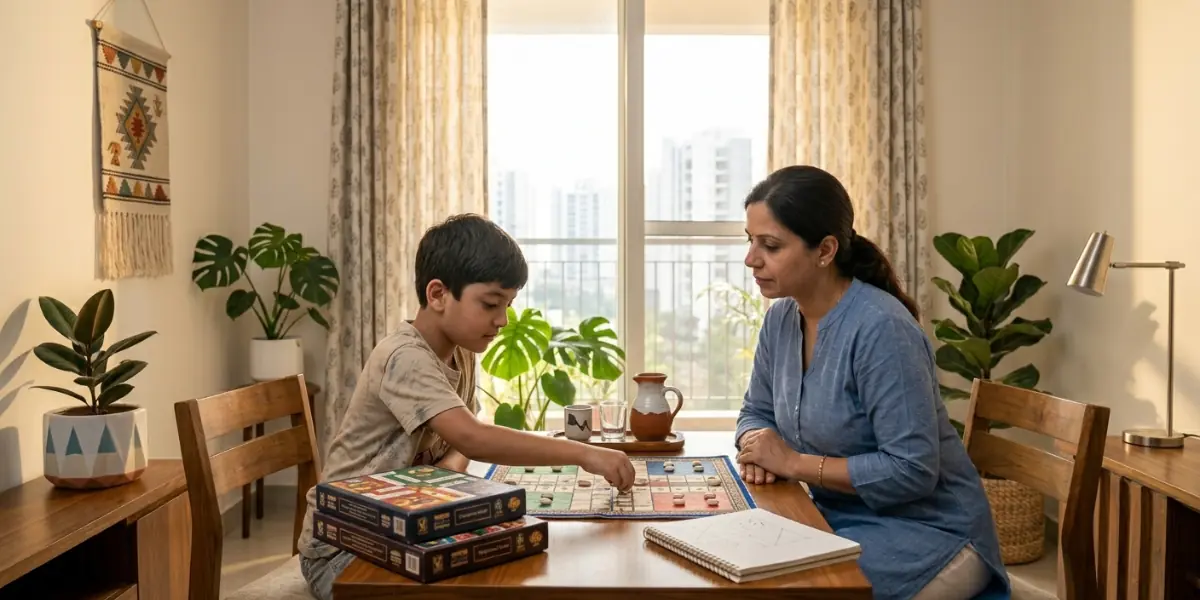
While Pachisi is the “people’s game,” Chaupar is its more complex, sophisticated cousin. Traditionally played on a cruciform cloth (pasha), it was the game of royalty.
Understanding Chaupar rules for kids helps parents introduce structured thinking while keeping gameplay simple and engaging.
The Pachisi vs Ludo comparison becomes even more interesting when Chaupar enters the conversation, as it represents a deeper strategic layer beyond both.
- Why it’s Back: In 2026, parents are moving away from “mindless” games. Chaupar requires players to manage four pieces simultaneously, teaching children about long-term planning and delayed gratification.
- The “Handshake” with Agency: As we discuss in our professional lives, strategy is about resource management. Chaupar teaches a child that one bad roll doesn’t lose the game—it just requires a pivot in strategy.
3. Beyond the Board: Goti, Pallanguzhi, and Adu Puli Attam
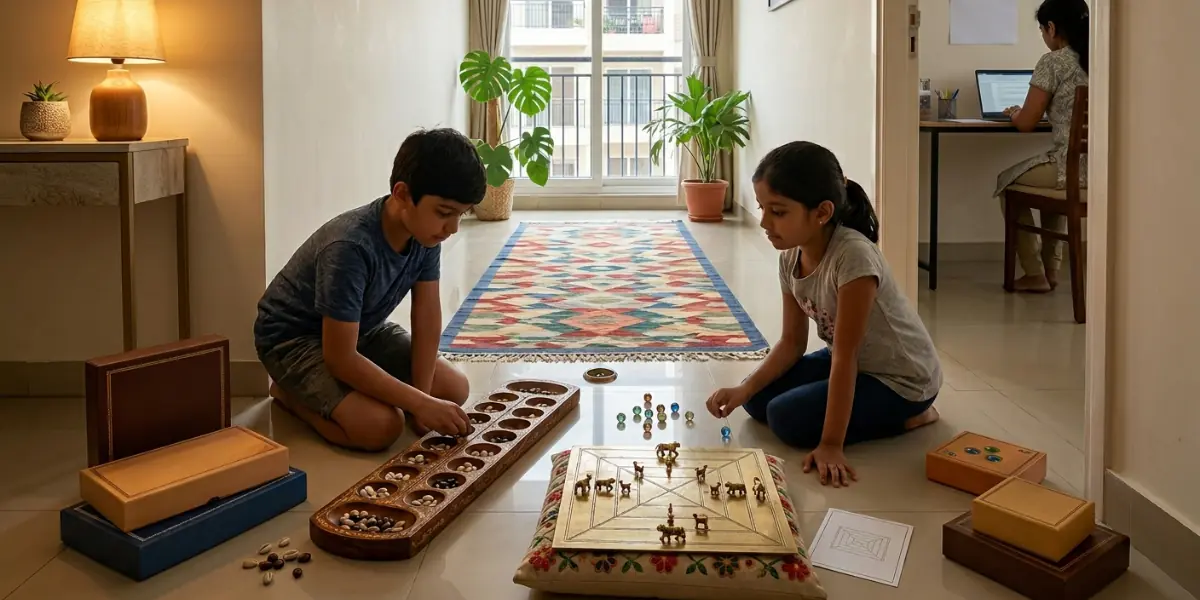
The revival isn’t limited to the “Big Two.” Across India, regional indoor games are being rediscovered: Traditional Indian indoor games are now being preferred over passive screen time because they encourage movement of mind and hands together.
- Goti (Marbles): While often played outdoors, a long hallway in a cool apartment is the perfect “bowling alley” for marbles. It develops fine motor skills and hand-eye coordination that tablet “flicking” simply cannot replicate.
- Pallanguzhi: This pit-and-peel game from South India is a masterclass in counting and “sowing” logic. It is remarkably calming and can keep a child focused for an hour—the perfect “Quiet Time” activity while you handle your [Work-From-Home Summer Audit]
- Adu Puli Attam (Goats and Tigers): This asymmetric strategy game teaches “the power of the many vs. the power of the one.” It’s an ancient version of a logic puzzle that sharpens the prefrontal cortex.
4. The “Dadi Maa” Logic: Why These Games Win in the Heat
There is a biological reason why these games have survived for millennia in the Indian subcontinent.
- Thermal Regulation: These are “low-metabolic” games. Unlike active physical play, board games keep the heart rate low and the body still, preventing “heat stress” and dehydration during peak afternoon hours.
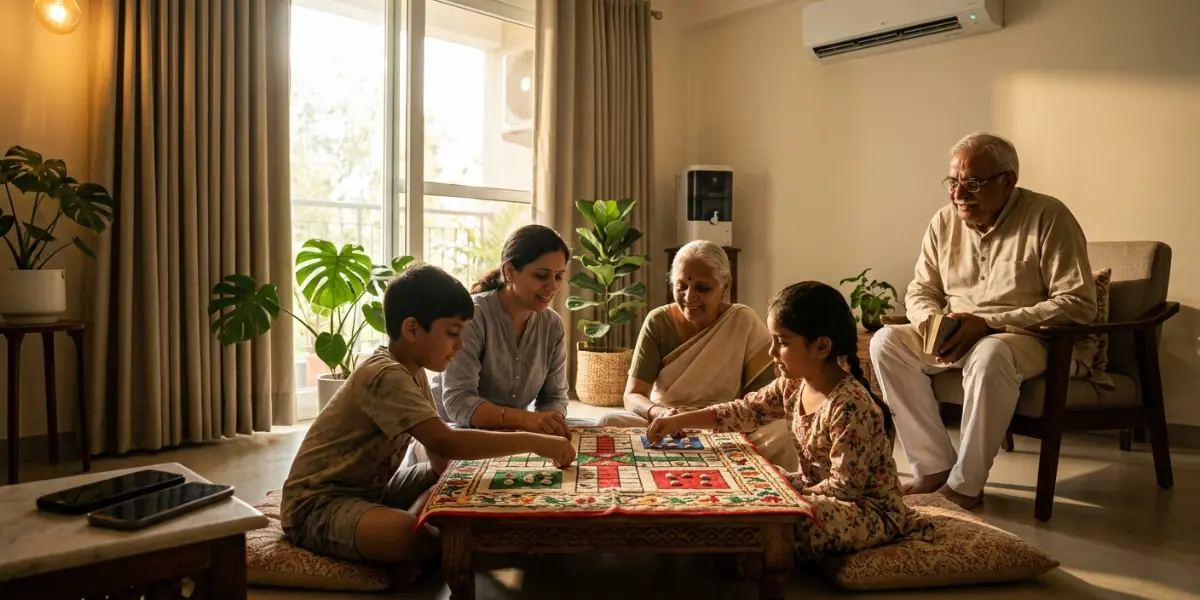
- Intergenerational Bonding: These games are the “Social Glue.” In May, when many children are at their nani’s house, Pachisi provides a bridge. It is one of the few activities where a 6-year-old and a 60-year-old are on equal footing.
Many parents also learn Chaupar rules for kids at this stage, so grandparents can actively participate in structured play sessions.
5. Setting Up Your “Ancient Game” Corner
To make the revival work, you need to move beyond the plastic versions.
- The Aesthetic: Invest in a handcrafted cloth board (Kalamkari or silk) and wooden or brass pieces. Making the game look “special” increases the child’s perceived value of the activity.
- The Ritual: Make it a daily 3 PM ritual. Serve some chilled aam panna or sattu, dim the lights, and let the rhythmic sound of the cowries become the soundtrack of your summer.
This structured play routine becomes one of the most effective indoor activities for kids in Indian summer, especially during peak heat hours.
The Strategist’s Closing Thought:
We often think of “progress” as moving forward into the digital unknown. But sometimes, the best way to move forward is to reach back. By introducing Pachisi and Chaupar, you aren’t just filling time; you are connecting your child to a lineage of thinkers, strategists, and storytellers rooted in traditional Indian indoor games.
Ready to fuel their big wins? Don’t let a mid-game “sugar crash” ruin the fun. Download our Summer Tiffin Survival Guide PDF for snack ideas that keep their energy stable and their minds sharp during the longest afternoon matches.