Executive Function & Play: Designing a “Yes Space” to Stop the Hovering
If you find yourself constantly saying “Don’t touch that,” “Be careful,” or “Put that down” while trying to draft an email, you aren’t just exhausted—you are suffering from “Correction Fatigue.” Setting up a dedicated space for toddlers can completely shift this dynamic at home.
In developmental psychology, we talk about executive function: the brain’s ability to plan, focus, and multitask. For a child, the best way to build this isn’t through a worksheet; it’s through uninterrupted play. But for a parent working from home, uninterrupted play only happens when the environment is safe. Enter the “Yes Space.”
1. What is a “Yes Space”?
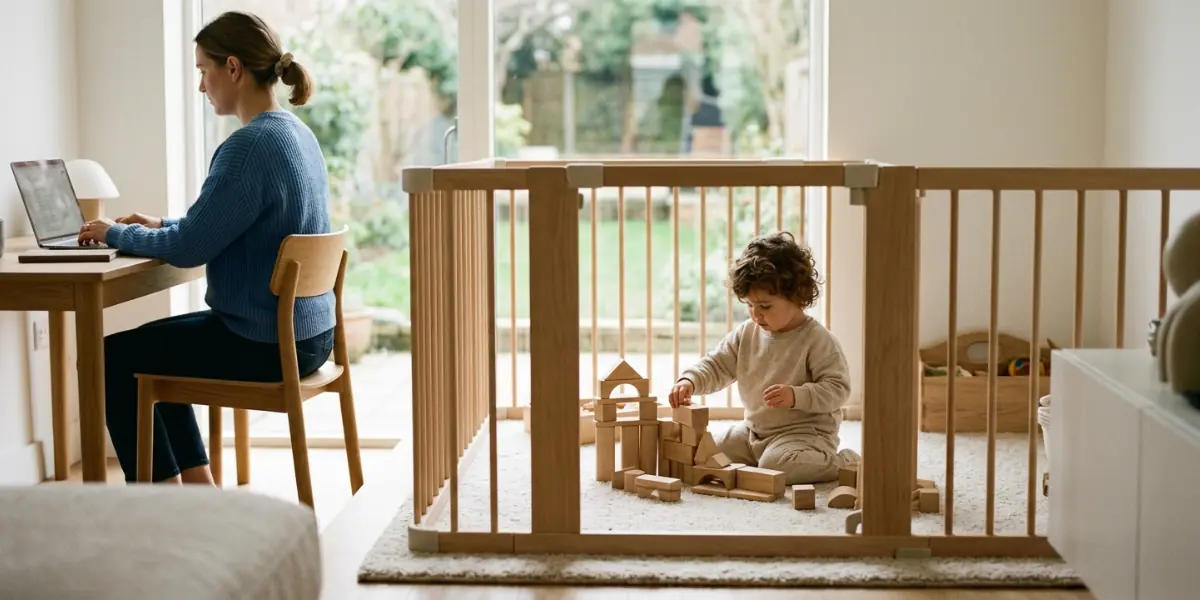
A “Yes Space” is a physically bounded area where every single thing the child can reach is safe for them to touch, mouth, and explore. Ensuring a setup centered around safe exploration for kids reduces parental anxiety and boundary testing.
- The Strategy: By removing the need for constant “no,” you allow the child to enter a “flow state.”
- The Benefit: This is where Deep Play happens. When a child isn’t waiting for a parental correction, their brain starts to initiate its own sequences—the core of preschool executive function
2. Designing for Independence (The WFH Handshake)
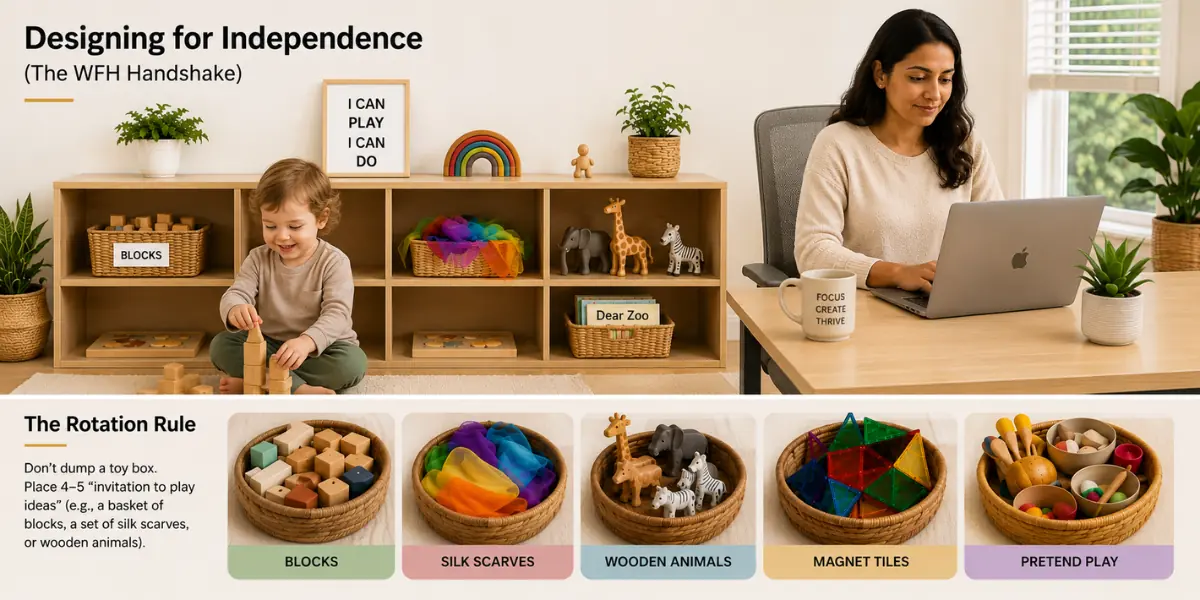
As we discussed in the [Work-From-Home Summer Audit], your productivity relies on their independence.
- Low Shelves, High Agency: Use open, low shelving where toys are displayed clearly.
- The Rotation Rule: Don’t dump a toy box. Place 4-5 “invitation to play ideas” (e.g., a basket of blocks, a set of silk scarves, or wooden animals).
3. The Physical Boundaries
- For Toddlers: A gated area or a specific room with a baby gate.
- For preschoolers: A designated “Creation Station” with a rug that defines the “mess zone.” This structured freedom directly nurtures preschool executive function by teaching them physical boundaries.
- The Aesthetic: Keep it neutral. Overstimulating bright plastic colors actually shortens a child’s attention span. Think wood, fabric, and natural light.
4. The “Scaffolding” Technique: How to Step Back
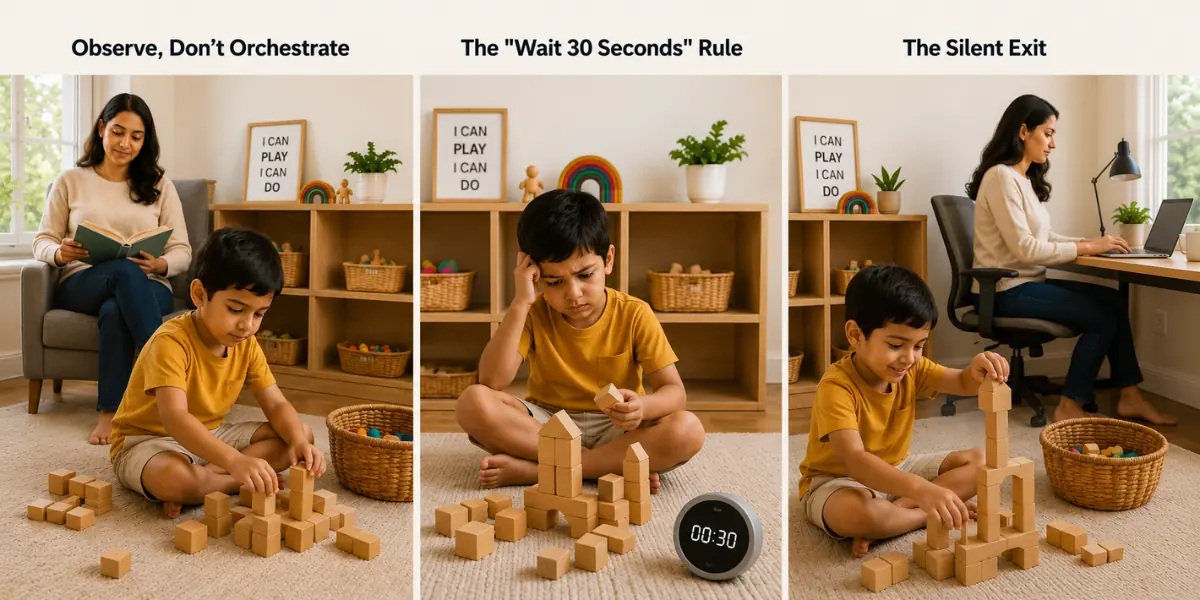
Designing the space is only 50% of the work; the other 50% is your behavior within it. To build a child’s executive function, you must practice “Strategic Withdrawal.”
- Observe, Don’t Orchestrate: Sit in the room but don’t “play” with them. Read a book or check your emails. Your presence provides safety, but your lack of interference provides the opportunity for them to lead. Setting up simple invitation to play ideas beforehand ensures they have a clear starting point.
- The “Wait 30 Seconds” Rule: When you see your child struggling with a toy, do not jump in. Wait. Let them feel the frustration. This is the exact moment their problem-solving brain kicks in.
- The Silent Exit: Once they are in a “Flow State” (deeply focused on a task), quietly move to your desk. This is the ultimate “Yes Space” win.
5. Maintenance: The Saturday Reset
A “Yes Space” becomes “visual noise” if it isn’t maintained. Applying a few intentional playroom organization hacks will keep the area functional for the long term.
- Toy Rotation: Every Saturday night, swap out 50% of the items. A “new” old toy feels like a brand-new discovery on Monday morning.
- Visual Order: Ensure everything has a “home.” A basket for balls, a tray for puzzles. Visual order leads to mental order
The Professional Payoff
As a strategist, you know that focus is a finite resource. Every time you have to shout “No!” from your desk, you lose 20 minutes of deep-work momentum. By investing in a functional yes space for toddlers, you aren’t just being a “good mom”—you are being a smart professional. You are creating a system that allows your business and your child to grow in parallel.